0 items
view cart

CBD and Acne: Benefits, Studies and How to Use for Healthier Skin

Temps de lecture
⌛
6 min
Acne is a common skin condition among teenagers, and can be very difficult to deal with, leading to problems that can be irreversible: pimples, scars... To get rid of it, various drug treatments can be effective. However, they do not work in all cases, and some can have serious side effects.
This is precisely what makes CBD so interesting. Numerous studies have proven CBD's effectiveness in the treatment of acne, thanks to its anti-inflammatory and sebum-regulating properties and its lack of harsh side effects.
How does CBD affect the skin? What are the proven effects of CBD? How can I use it? In this article, we explain everything you need to know about CBD's action against acne, with scientific studies to back it up.
What is acne?
Acne is a common dermatological condition characterized by the appearance of red pimples, blackheads and cysts; in severe cases, it can take the form of pustules.
The areas most often affected are the face, neck and sometimes the chest and back.
In most cases, acne is a hormonal phenomenon that appears during adolescence (around age 12) and disappears spontaneously between the ages of 18 and 20.
It affects around 80% of teenagers (15% of whom have severe acne) and 25% of adults. [1]
How does acne appear? The main causes
Acne affects the hair follicle at the root of the hair, where the sebaceous glands produce sebum, a protective grease that prevents skin dryness. Due to the high production of androgens (male sex hormones), these glands produce excess sebum, which clogs the sebocyte ducts.
Whena pimple appears, it is due to several factors:
- Blockage of follicles by accumulation of dead cells
- Bacterial growth (Cutibacterium acnes)
- Inflammation of the sebaceous glands
- Hormone-induced sebum overproduction
In the most serious cases, if left untreated, acne can lead to permanent scarring. That's why it's so important to monitor and treat acne effectively.
Aggravating factors of acne
Acne and stress
Stress is one of the causes of excessive sebum production. Indeed, many nerve cells are present near the sebaceous glands, and these cells can produce a substance P which acts on the overproduction of sebum.
Endocannabinoid receptors
Like stress, endocannabinoid receptors, principally CB2 in the sebaceous gland, can aggravate acne by stimulating the overproduction of sebum.
The psychological impact of acne
Acne is a real problem for teenagers, causing psychological problems at an already delicate time.
In fact, acne can be a source of stress, which is an aggravating factor. This creates a vicious circle.
Medical treatments for acne
Traditionally, acne has been treated with local or oral anti-acne medication, usually containing an antiseptic and sometimes antibiotics or retinoids (vitamin A derivatives)[2].
The latter are not without side effects such asvomiting, diarrhea, bloating, etc.
Effects of CBD on Acne
Cannabidiol (CBD) is one of the main molecules found in the hemp plant (Cannabis Sativa L.). Like the well-known THC, CBD has no psychotropic effects, risk of dependence or major side effects, but unlike THC, it is legal in many countries.
CBD acts by regulating sebum production via its interactions with CB1 and CB2 receptors. What's more, its anti-inflammatory effect calms the redness that can occur with acne. Recent studies indicate that it may be effective in reducing acne.
CBD and Acne: Clinical Studies
CBE and its role in sebum production
A 2009 study[3] highlights the role of CB2 receptors in sebaceous glands in excessive sebum production.
By acting precisely on these receptors, CBD helps regulate sebum production.
Researchers have observed that CBD directly inhibits lipogenesis (the body's synthesis of sugars and fatty acids) and suppresses the proliferation of sebocyte cells responsible for excess sebum. Thus, by reducing sebum production, CBD contributes directly to the reduction of acne.
The sebostatic role of CBD
Another study from 2014[4] suggests that CBD acts as a sebostatic agent. By administering CBD to cultures of human sebocytes, the researchers observed a reduction in their proliferation and a decrease in sebum production via activation of TRPV4 (Transient Receptor Potential Vanilloid-4) ion channels.
This would tend to prove that CBD can also regulate excessive sebum production by acting directly on skin tissue.
The anti-inflammatory and calming effect of CBD
Finally, a last study[5] demonstrated the major role of inflammation in the appearance and aggravation of acne, pimples and redness, as well as the calming effect of CBD.
Thanks to its anti-inflammatory action, CBD acts as a modulator of skin inflammation. Through a complex action on inflammatory mediators (such as TNF-α (Tumor Necrosis Factor alpha), IL-6, IL-8 and IL-1β cells, etc.), CBD is said to be able to soothe acne lesions and prevent the appearance of redness.[6]
The effects of CBD on acne scars
In severe forms, acne can leave indented marks and scars. An Italian study published in 2019[7], carried out on a small sample, administered CBD to the skin of around 20 participants who had scars linked to psoriasis and atopic eczema.
After three months of treatment, the researchers found that CBD had significantly improved the appearance of the skin, particularly its elasticity and hydration.
Although the study was not carried out directly on acne scarring cases, it would tend to show that CBD products could help reduce the appearance of acne scars.
Treating acne with CBD oil
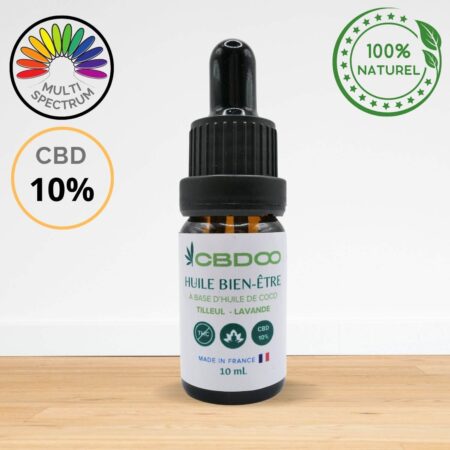
In addition to its multiple effects on sebum production and skin inflammation, full-spectrum CBD oil also contains vitamins B, C and E as well as omega 3 and 6 fatty acids, deficiencies of which can lead to skin problems including acne.[7]
This is one of the most effective ways to treat acne with CBD.
To do this, you can use CBD oil as a skin application, applying a few drops to the skin morning and night.
You can also use oil or capsules for oral treatment. In the case of oil, simply place a few drops directly under the tongue for about a minute.
Although CBD has no serious side effects, it's advisable to start with the lowest dose, then gradually increase the number of drops if necessary.
For post-acne scars, we recommend using CBD in ointment or cream form, or applying CBD oil (5% concentration) directly to the skin.