0 items
view cart

Discover THC-P's twin, THCB!
Temps de lecture
⌛
3 min
We told you about THCH last week, but here's another new discovery in the vast world of cannabinoids: tetrahydrocannabutol or THCB.
Like all cannabinoids, it is responsible for interactions with the endocannabinoid system which, according to preliminary studies, could lead to a range of potential therapeutic benefits.
Is it natural? What are its effects and potential benefits? How did researchers discover it? As usual, we tell you everything you need to know about the new kid on the block!
The discovery and synthesis of THCB
To begin at the beginning, and to tide you over before getting to the heart of the matter, let's talk about the discovery of this compound. Like THCH, THCP and CBDP, THCB was discovered in 2019 in Italy on a variety that's about to become famous through discovery: FM2.
Like these two other cannabinoids, THCB has only been found in trace amounts in the plant. It is present in infinitesimal quantities, well below 0.1%. This has two implications: the classification of this compound as a secondary cannabinoid, and the impossibility of extracting the compound directly from the plant for commercial production.
This last point therefore implies that THCB can be classified as a semi-synthetic cannabinoid, since it exists in its natural state, but is necessarily the result of synthesis.
Speaking of synthesis, how does it work? Once again, it's almost exactly the same as THCH. It's the product of a chemical operation called terpenulation. This involves subjecting a terpene to a chemical reaction using a chemical precursor. In simple terms, the molecules present in the terpene are added to those in the reactor to produce our cannabinoid.
In short, and to put it very simply, it's a bit like adding dyhydrogen (H2) and oxygen (o) to form H2O: water.
What's the difference between THC and THCB?
To better understand the uniqueness of this new compound, we need to compare it with a well-known compound: THC.
Thcb has a butyl side chain, hence its name tetrahydrocannabutol, unlike THC, which has a pentyl side chain. What this means is that the molecule's side chain doesn't have the same number of carbons. They say a picture is worth a thousand words, so here's how it manifests itself:
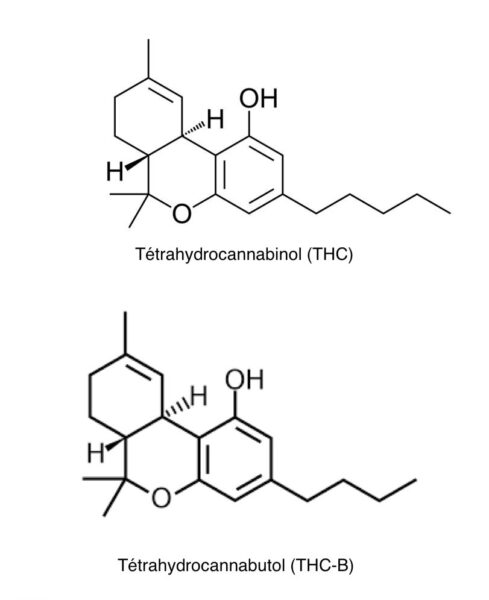
This butyl chain differentiates THC-B from THC, implying different effects that can be explained by a different impact on endocannabinoid receptors.
Potential medical applications of THC-B
For the moment, with studies still in their preliminary stages, the effects of THC-b have only been tested on mice. On these mice, THC-b has shown the following properties:
- Anti-inflammatory,
- Analgesics (painkillers)
- Anticonvulsants
However, as you'd expect, these properties have yet to be demonstrated in humans. That said, the similarities noted suggest that it works in a fairly similar way to the other molecules in its family, so its properties and potential medical applications appear to be much the same.
Is THC-b legal?
This compound has been legal for some time for the simple reason that it was not banned. The health authorities responsible for ruling on the risks associated with its consumption have decided to ban the compound on June 3, 2024.
Like HHC before it, THC-B could end up being banned because of its psychoactivity and possible addictive effect.
Is THCB safe?
As with any chemically manipulated product, cannabinoid or otherwise, THC-B is safe, provided that it is synthesized according to the rules of the art. Nevertheless, all synthesizing can leave traces of harmful products which must be separated at the end of the process, and we don't yet know enough about the molecule to assert that there is no danger in consuming it.
-
Follow our blog to make sure you don't miss out on any developments in the vast world of cannabinoids!